
PRESENTING THE GOOD OLD E&N

VICTORIA, B.C., SATURDAY, AUGUST 1, 1970
Take a Ride on It (While You Can)

By DON VIPOND
A day on the Dayliner—there’s the trip everyone says they’re going to take—some day. This week Times reporter Don Vipond and his wife took it. His report:
We have our own Rock Island Line. It could be a mighty fine line. But it isn’t.
The Dayliner runs from Victoria to Courtenay and return daily except Sunday.
It’s a 140-mile ride through forest, wild salmon, rushing waterfalls, serene lakes, island history and back country. It runs precisely on time. It’s an easy, easy way to travel, friendly and relaxed.
But a day on the Dayliner is frustrating. The operation lacks tender, loving care, cutbacks at the top who give a damn.
In a word, it is shabby.
The shabbiness starts with the Esquimalt and Nanaimo Railway building, on Store Street and Johnson, where it all begins at nine in the morning. Take a look next time you’re passing.
The Dayliner itself is a single car, a self-propelled diesel seating 48 passengers. It is smooth, fast and quiet. Its snout has the CPR paint stripes. The paint is peeling.
The interior décor might be called Post War Tedius. Wall and ceiling are drab strawberry and off-white, meaning grey. Chairs are covered in exhausted blue something or other but they are comfortable.
Signs tell you "smoking" is okay. So is "fumeurs." There is a washroom. That’s about all you can say for it.
The Dayliner is air-conditioned. The conditioner gives the air that faint canned flavour only railways manage to produce.
And it really does rock. The car is light and fast and the track weaves. Walk the aisle and you are constantly left in the lurch.
The engineer works his horn like a Parisian taxi driver. Later, riding up front, you see why. There is an appalling procession of roads, tracks and trails crossing the line. And always another blind bend ahead.
Impressions along the way:
In the Goldstream rain forest, the right-of-way is so narrow, like rushing down a chlorophyl tunnel. Ferns and bushes right alongside bow and wave madly in the slipstream. Sort of makes you feel welcome.
A doe, caught out in some slash, bounces away.
Here the railroad company has fought the encroaching foliage with some potent spray which shivels and colours the leaves. So you pass between ribbons of autumn colours, wall of summer green behind them.
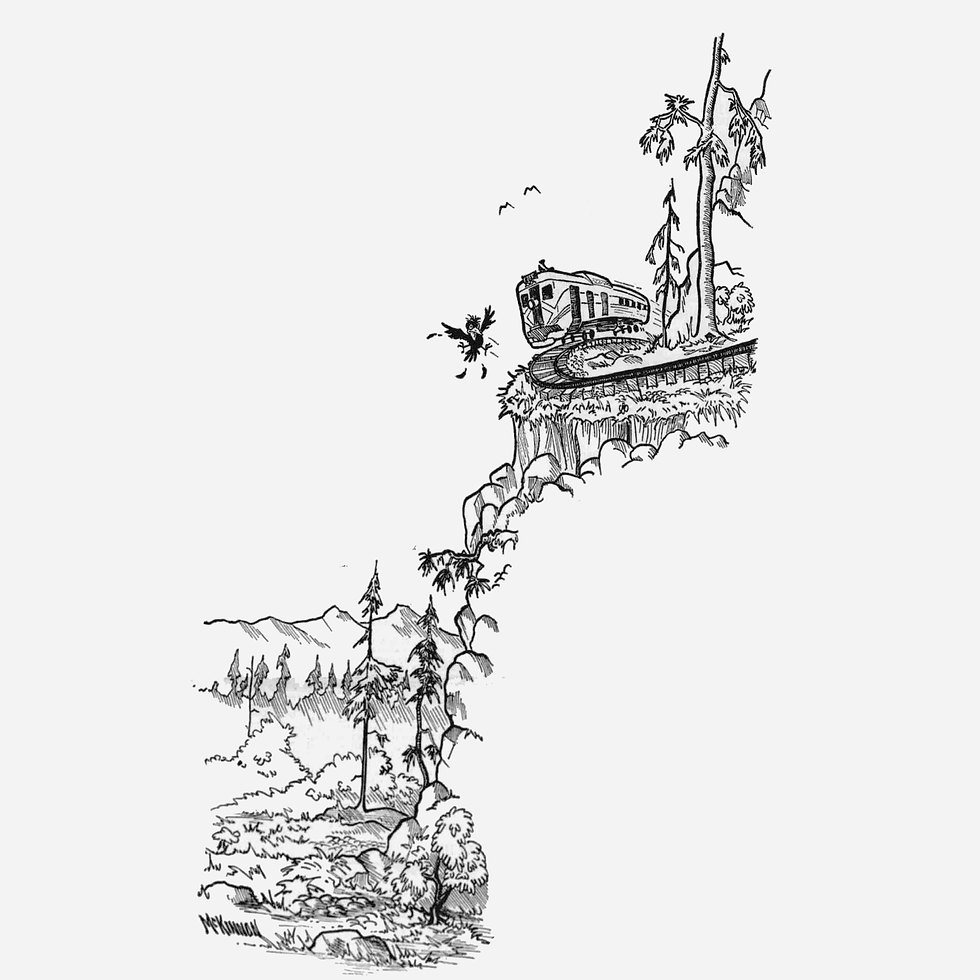
At Niagara gorge the Dayliner takes wing. The trestle underneath is hidden and you are flying the rocks 280 feet below. The track is above the Malahat highway and the view is better. It’s gone too soon.
Near Shawnigan the sun comes out to brighten lonely little farms in a rolling valley. Where are the roads? How do these people get out? Maybe they don't.
There must be roads of some sort nearby because there are corpses to prove it. Car bodies, now and again, throughout the whole 140 miles. There is one behind a stump, another overturned in a shallow pothole in the middle of nowhere. That one just had to belong to Bonnie and Clyde.
Duncan, an hour and 14 minutes into the mission. The Dayliner has a bell so we carol our way through Duncan. Lots of raspberry bushes right beside the track and the raspberries are ready. The windows won’t open.
At Nanaimo, the Dayliner ambles through the backyards of small frame houses where women ignore it as they hang out the laundry. The kids wave. We wave. There are a lot of kids in Nanaimo.
Nanaimo’s dogs are something else. They race the Dayliner, too lazy to bark. Maybe it is a daily losing sprint but there are no quitters. Their tongues are all a foot long.
Island there is fireweed to brighten the slopes and many brown cows. They are too busy chewing to look up.
A man who takes the trip often says kids sometimes climb into the water barrels on the trestles to await the Dayliner’s passing. Sort of a chicken game.
"It really shakes the bridges. It shakes them fast. You can see the expression of the girls’ faces. They’re terrified."
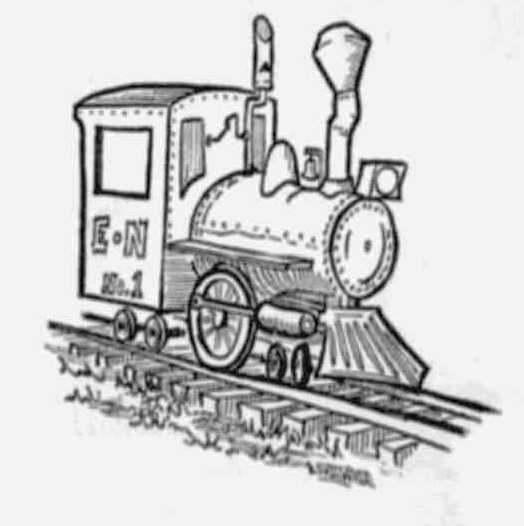
There are only a few main stops along the way but there are close to 40 flag stops, optional halts if anyone wants off or on. Some are marked with tiny roofed waiting rooms at road crossings.
The Dayliner usually stops for about 10 seconds. And it really moves out. It has two diesel engines, a total of 525 horsepower. Because soundproofing is good, you only hear an increasing whine as the trees start to whiz past.
Too bad there isn't a ferry trip down Georgia Strait to complete the circle. Or a rail run down to Alberni, then ferry to Bamfield and back home.
Too bad there isn't a steam engine or an observation car or open windows or snack bar.
Too bad.
Middle Column (Top Section)
Rails Could Be Silver, Spikes Could Be Gold
By JOHN SLINGER
Here’s the picture, all sepia tones. Place called Cliffside by Shawnigan Lake. A train hauling a couple of Pullmans has stopped. In front of the cow catcher a knot of people on the grade. Women with parasols, men in toppers, boiled collars.
Sir John A. Macdonald is there. And his wife. So are a lot of the men who worked to build the line, as well as islanders mingle with them, looking pleased.
It is the first official run on the Esquimalt and Nanaimo Railway. The first 63 miles —from Esquimalt to Nanaimo—is laid. Old Sir John is about to drive the last spike. The sledge is silver-plated. The spike is gold. It’s a warm afternoon in August. A Friday. Friday the 13th.
And if anybody thinks there’s nothing to superstition, about Friday the 13th, call up the Canadian Pacific Railway and ask them about that side line of theirs called the Esquimalt and Nanaimo.
Looking back over Canada’s first 100 years or so, it is suggestions from civic types over the years, everybody expects CPR to pull itself together. The Islanders feel that the railway, when it bought the E and N, did not get the sow’s ear it deserved. It got a silk-purse mother lode.
It got such a deal, goes the refrain, that the CPR owes the Island passenger service even if it goes broke providing it.
An Historical Note:The line was actually built by a group headed by Robert and James Dunsmuir. The Dunsmuirs were making a bundle mining coal at Nanaimo. They wanted to get their coal to ships at Esquimalt.
They got into the act because Sir John A. was having troubles with, it seems, everybody; his caucus, the senate, the privy council, The B.C. government and “those bumptious Islanders”.
Since the CPR wasn't coming and the Islanders were threatening to get out, the provincial government went along with the Dunsmuirs.
It gave them besides 750,000 federal dollars, a 20-mile-wide strip of land between Victoria and Nanaimo.
Included were the rights to "all ores, coal, oil, stones, clay, marble, slate, minerals, timber and substances in, on or under the lands." Or under the waters.
In return the Dunsmuirs would build and operate a railway and telegraph line. It was all tax free.
With the federal money, it only cost the Dunsmuirs another $2.25 million to do the job.
The CPR bought them out in 1905 for $1.25 million—$1 million less.
CPR thought it was a tax free operation too — until 1946 when B.C.’s Chief Justice John Farris disabused them of that.
The following year a land tax of 25 per cent was imposed on woods and land sales.
Began the troubles.Between 1950 and 1955, CPR paid almost $3.1 million in taxes.
Said Municipal Affairs Minister Dan Campbell in 1968 when the CPR first applied to discontinue passenger service: CPR cannot leave without paying compensation, lands or cash. To do otherwise would be a breach of contract.
★
"The federal government should not break faith with the people of Vancouver Island."
And a similar noise from mayors and private citizens, that application was dropped.
But this year the CPR has gone back to the Canadian Transport Commission and proved it lost $102,455 in 1966; $115,880 in 1967 and $188,131 in 1969.
Mayor Courtney Haddock in Victoria thinks the line is important. It could be a tourist draw. Mayor Frank Ney in Nanaimo thinks it could be important. Revise the schedule.
It was ever thus. The federal commissioners will have to decide after Wednesday.
A further historical note:Victoria, June 2, 1883. The Board of Transport Commissioners is looking all standard into E and N service. Before them is doughty old George E. Bonner of Cobble Hill, president of the Vancouver Island Taxpayers Association.
★
He says: "The E and N service is convenient to no one and its equipment is obsolete.
And he says: "If the E and N Railway had used all the money from sales of crown-granted land and mineral rights for improvement of its railroad, we would have had a double track with rails of silver and spikes of gold between Victoria and Seymour Narrows."
He died in the spring of 1968. His expression linger.A Final Historical Note:
From a report in the Daily Colonist, Aug. 23, 1886, concerning the driving of the last spike:
"The remark of Sir John that the road was 'an extension of the Canadian Pacific Railway' evoked many cheers."
Right Side Feature Column
It Just Misses All The Time
The Dayliner arrives in Nanaimo at 11:10 a.m. six days a week—just in time to miss connecting with the ferry to Vancouver.
It arrives in Courtenay at 1:10 p.m., just as the bus for Campbell River is disappearing down the highway.
It arrives back in Victoria at 5:30 p.m., as the ferry to Seattle is nicely under way.
BUT—if the Dayliner is precisely on time—and you can run like a deer—you can just catch the ferry to Denman Island in the morning on the up-island run.
These are some of the points the critics make.
They also ask why the Dayliner doesn’t begin its run from Courtenay, lay over in Victoria for two or three hours of business or shopping, then take up-islanders home.
CPR wants to discontinue the Dayliner because it’s losing money. The critics say: "No wonder."
CPR Again Tries To Get Rid Of It
Wednesday morning, in Victoria’s Law Courts Building, the Canadian transport commission’s railway committee will open a hearing into Canadian Pacific Railway’s application to discontinue its Island passenger service.
It is CPR’s second application to end the Esquimalt and Nanaimo Railway Dayliner service between Victoria and Courtenay. CPR claims the operation loses money.
In 1968 the application was dismissed following a barrage of protest from community organizations, citizens and municipalities along the route.
CPR now has carefully documented its losses and will attempt to prove that continuing the service is no longer necessary or economically feasible.
Bottom Feature Article
Arthur Mayse ...
AS A COMPULSIVE talker in print, I’m not in the habit of turning this space over to others. But an issue of importance to Vancouver Island readers is coming to a head, and today I intend to break my rule.
Acted as private citizens, Alderman Brian R. D. Smith of Oak Bay and Peter Pollen of Victoria have submitted a highly pertinent brief to the Canadian Railway Transport Commission. The committee has before it a CPR application to discontinue passenger train service on its line operating between Victoria and Courtenay.
The Smith-Pollen contention, arrived at after a review of the agreement between Esquimalt and Nanaimo Railway builder Robert Dunsmuir and the federal government, is that the CPR purchaser remains bound by the terms of that deal.
"Now, their brief continues, "the Canadian Pacific Railway wishes to discard what it believes to be an unprofitable and nuisance-adjustment to its over-all service.
"We do not feel that the company should be permitted to do so, unless, of course, it proposes returning to the public of Vancouver Island some of the lands and minerals which it acquired taking with the line in 1905.”
The authors of the brief then claim that the CPR "has not made a reasonable attempt or attempted in good faith to maintain and promote passenger service on the E and N line in later years.
"We are not aware of any effective advertising campaign or attempt by the railway company to attract passengers on the Island line. The various stations at which the train stops are for the most part, drab rundown relics of another age.
"Facilities at the Victoria terminus do not attract the traveler or the tourist so far as station quarters, available information or ready parking are concerned."
Pollen and Smith conclude their submission by weighing the future potential of passenger railway service on the Island.
"The Island Highway from the Malahat north,” they note, "is largely one lane each way, and is in many places a narrow road that would be extremely expensive to widen. Tourist traffic in the southern part of the Island from May to September appears to be steadily on the increase. The highway is extremely congested and at times unsafe... We feel that many tourists and local travelers could readily be induced to take the railway as a restful and comfortable way of seeing Vancouver Island, and enjoying far better scenery than can be seen from an automobile.
"The E and N trip from Victoria to Duncan offers a spectacular and unique view of the country, provided by no other route.
"Finally, we feel that the increased urbanization of the Greater Victoria area and southern Vancouver Island, the rise of tourism and the congestion of the single highway, all point to the need in the early future of some form of alternate system of rapid transit distinct from that highway.
"Surely the capital cost to the country would be much less to extend modern and efficient passenger service over the E and N line, rather than to embark upon an inevitable future program to widen and improve the Highway to cope with the increased traffic.
"We would hope that the Dominion and Provincial governments would both be alert to the potentiality of the Esquimalt and Nanaimo Railway, and that further studies could be conducted upon in the public interest.
"In summary, we urge the Committee to insist that the Canadian Pacific Railway maintain continuous passenger service in accordance with the spirit of the original undertakings, and that in any event, a passenger line be maintained on Vancouver Island in the public interest of Canada."
As an Islander who subscribes most heartily to that wish, I hope Railway Transport Committee will not confine their sitting to Victoria Courthouse, where a public hearing on the CPR application is scheduled for August 5.
A journey by E and N to Courtenay, and a return by car over the Island Highway, could be enlightening in more ways than one.


Comments