
Theophilus Elford

(excerpt from
"THE SHAWNIGAN LAKE LUMBER COMPANY"
1889 - 1943
by
ROBERT BRIAN GRIFFIN
B.A., University of Victoria, 1973
A THESIS SUBMITTED IN PARTIAL FULFILLMENT
OF THE REQUIREMENTS FOR THE DEGREE OF
MASTER OF ARTS
Theophilus Elford, affectionately known as "Pop," figured prominently in the success of the company. He was the manager of both the saw milling and the logging operations, taking over as soon as Morrison left. Pop was born in San Rafael, California, April 24, 1854.
His parents had moved to California from Australia in 1849 and then followed the gold seekers to Victoria in 1859. Pop's father farmed in the area and then established himself as a building contractor. When his father returned to farming, one of his brothers took over the contracting business and established a brick works with William Smith.
Pop farmed until he went into the lumber business with William Munsie. The men who worked for Pop considered him not a "bad old stick" but reported that he seemed "up in the air all the time." J. Potter, a long-time employee at the sawmill, recalled that Pop was "bossy but not a bad old customer."
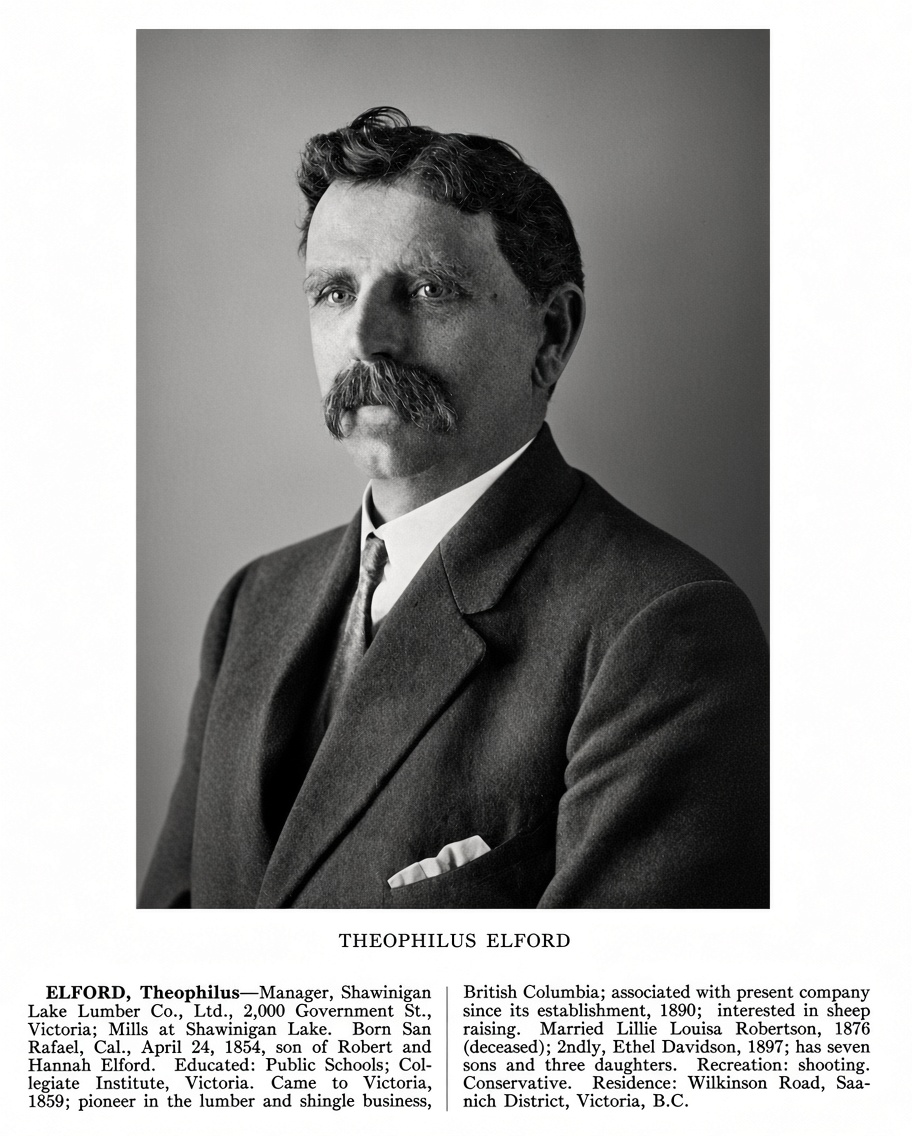
He would get worked up over little things. Potter remembered that on occasion Pop "would walk up and down the mill floor cutting a plug of tobacco and then rolling the plug in his han. . . finally throwing it on the floor and cut some more."
Eventually Pop would get some in his pipe and Potter would then remind him that according to his own regulations no smoking was allowed in the sawmill. Dan Hattie, who worked for the E. & N. Railway at the time, recalled that he and Elford "fought nearly every day."
My orders from the E. & N. were not to accept any timber
with more than one inch of sap on any corner. Old Pop
thought the grade was too high. He was a good old scout,
but sometimes hard to get along with.
One day I culled four timbers, because of my instructions
not to take any sapwood. This made Pop pretty angry who
said they were getting better than they were paying for anyway.
-- I believe the price was just over $7.00 a thousand. In a bit of
a scuffle that followed Pop had his white shirt torn off his back,
but he never held any personal grudge against me, although he
never reconciled himself to the railway's way of grading timber.
Pop ran the operation until 1916 when he became very ill and retired to
his farm at Foul Bay, where he died on July 25, 1917.
The employees always regarded Pop with special affection, and while his son Frank, who
took over from him, was a "good head," it was Pop who held their memories


Comments