
Memories of the Williams Creek Bridge

by Gerry Burch
I was involved in the construction of this bridge.
I was employed by BCFP as a cruiser at this time, but, in the winter months I was sent to a camp to act as assistant engineer. In the period of 1948 to 1960, I seemed to spend most of the winters at Bear Creek camp at Port Renfrew. All logging was by railroad at this time, and development was concentrated on the eastern portion of Block 191 at Bear Creek. This involved the construction of two bridges--one at Williams Creek, and one at Floodwood Creek.

During the second world war, the Army had constructed a road from Shawnigan Lake to the end of steel in order to service an Army installation at Port Renfrew, with gun placements to thwart any attacks from the sea.
The "end of steel "was a short distance from the east end of the Williams Creek trestle, at a location of a watchman's shack, called "Bert's Shack!" Here, the loggers in the San Juan valley would leave their cars for the week, for use on their time off on weekends, or whenever.
Around 1957, two events occurred: the logging of the east portion of Block 191 was complete, and there was a trend towards truck logging .
Therefore, the steel rails were picked up back to truck roads that were being constructed to the higher ground. In this area, the steel rails now ended at the east end of the Bear Creek bridge , where the new parking lot occurred. And, the bridges were planked over to allow vehicle travel.
At this time, a bus service from Shawnigan Lake was started on a twice a week trip, for workman, visitors, or freight. Also, diesel oil and gas trucks became common, but, after a few years, the old bridge structures began to show signs of wear, and concern was expressed as to their serviceability. Eventually, and I would say it was around 1960, a decision was made to replace the Williams Creek bridge, but, "do it as cheaply as possible, and make it safe for public use."
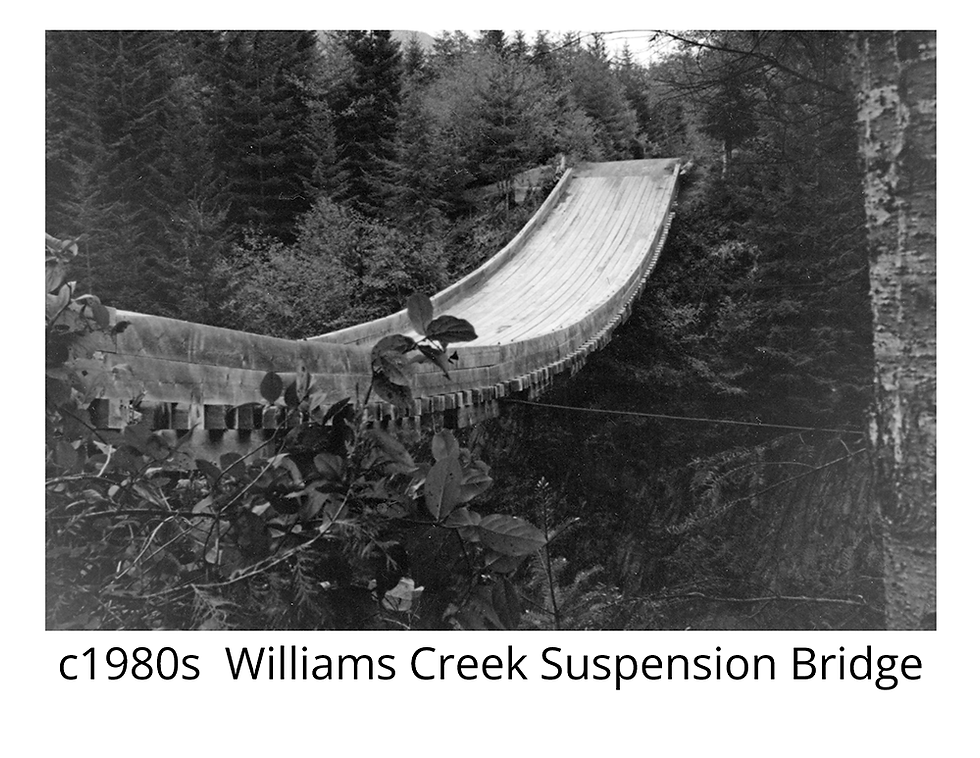
The camp engineer at this time was Glen Forrester, and we talked at length on a new design. It was Glen who came up with the "bedspring " design. But, two major problems presented itself--large cables would be needed, and the "deadmen" at each end must not fail!
At this time, the company was involved in building a connecting road from the Harris Creek operation on the north side of the San Juan valley to the operation on the south side, which involved a major bridge across the San Juan river.
This river is noted for flooding, and the bridge would undoubtedly be used to haul logging trucks, so, a suspension bridge was adopted. This involved large cables (rather than old logging cables). Fortunately, our Chief Engineer -BCFP-Jim Crickmay-heard that the Boston Bar -North Bend cable car crossing ,which replaced their cables every few years (for safety), and was trying to find a sale for considerable lengths of the perfect sized cable we needed for the San Juan Bridge, and we bought the cable.
Thus, Glen determined this was the perfect cable for his "bedspring" bridge, and determined that enough was available to construct four strands for his bridge. As for the "deadmen" he built the biggest cement blocks, well surrounded by rocks, and which never moved a bit, to my knowledge.
Yes, it was a bit of a scare crossing this bridge, but all were warned not to stop, but, just keep going!
And, it worked for many a year. Naturally, freight trucks or the bus were not allowed to cross.



Comments